
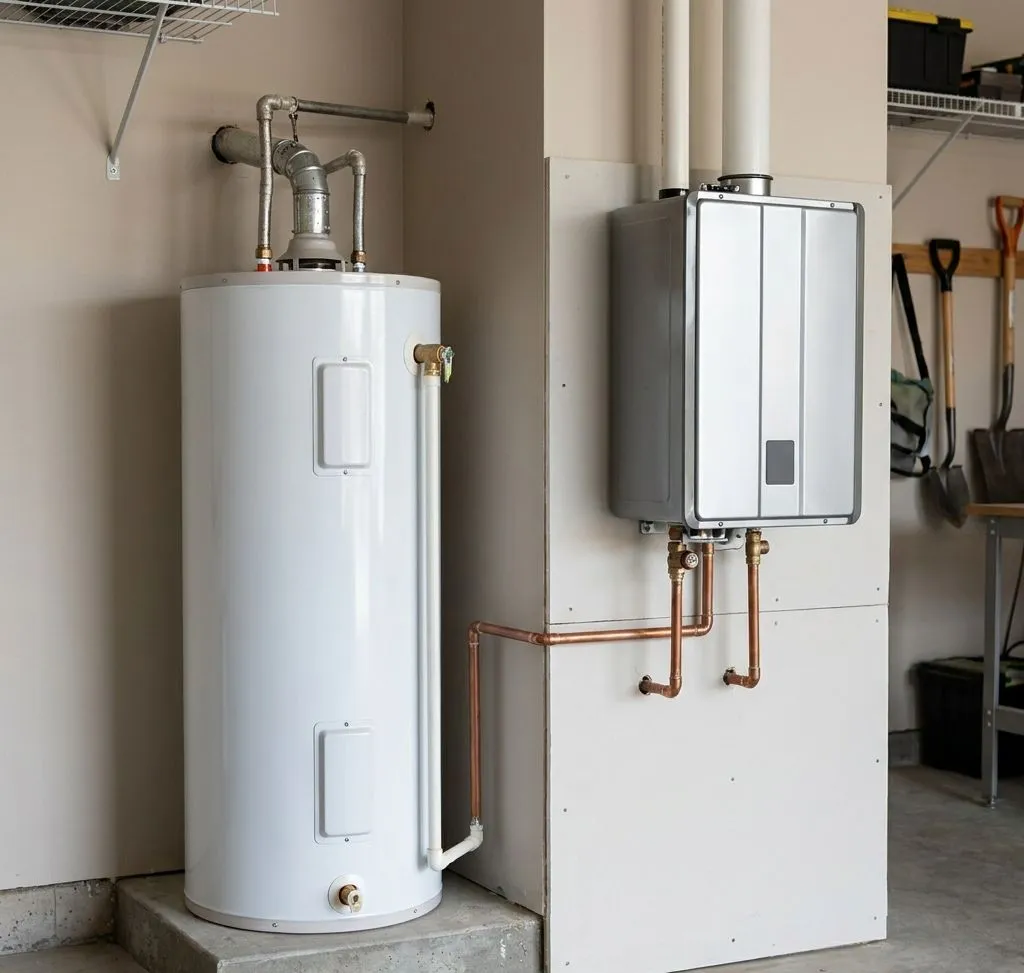
I install both tank and tankless water heaters every week. I've replaced plenty of tankless units that were the wrong call for the home, and I've also seen households run out of hot water with a 50-gallon tank that should have been sufficient but wasn't. The right answer depends on specific conditions, not general preference.
Here is how I think through this when a customer calls and asks.
The Short Answer for Most DFW Households
If you have a family of 4 or more and regularly run out of hot water, tankless is worth the investment. If you're a couple or a household of 3 that manages fine on a 40 or 50-gallon tank, a quality tank replacement is a better value and will serve you for another 10 to 12 years.
The decision gets more complicated when you factor in DFW-specific conditions, which I'll walk through below.
Tank Water Heaters: What They Cost and What to Expect
Purchase and install: $1,200 to $2,800 depending on tank size and whether you use a power-vent model.
Lifespan: 8 to 12 years for most residential units in North Texas. Hard water accelerates anode rod consumption and shortens tank life compared to softer-water cities.
Hot water capacity: A 50-gallon tank provides roughly 33 to 40 gallons of usable hot water (the rest is the cold buffer at the bottom). For a household that runs two showers simultaneously, that's a tight window.
Recovery rate: A standard gas 50-gallon tank recovers about 1 gallon per minute. After the tank empties, you're waiting 40 minutes for full recovery.
Energy use: Gas tank units are generally 60 to 70% efficient. Heat-pump electric tank units are up to 300% efficient but require specific installation conditions and a 240V circuit.
For a full list of signs that your current tank is failing, see our water heater failure signs guide.
Tankless Water Heaters: What They Cost and What to Expect
Purchase and install: $3,500 to $6,500 for a whole-home gas tankless. See our tankless installation cost breakdown for a detailed look at where the money goes.
Lifespan: 15 to 20 years with proper maintenance. The heat exchanger carries a 15-year manufacturer warranty on most Rinnai and Navien units we install.
Hot water capacity: Unlimited. A properly sized unit provides continuous hot water as long as gas and water flow. A Rinnai RU199iN at 11 gallons per minute can feed multiple showers simultaneously without a recovery period.
DFW condition: Groundwater in North Texas runs 60 to 70 degrees Fahrenheit in summer and 50 to 55 degrees in winter. A tankless unit needs to raise that to 120 degrees. In summer, a smaller unit handles this easily. In January, the unit works harder. Size for the winter demand, not the summer average.
Hard water impact: The heat exchanger in a tankless unit is more susceptible to scale buildup in hard water than a tank's heating element. Dallas water at 8 to 12 grains per gallon will require annual or biannual descaling without water treatment. This is real operating cost that tank advocates use accurately in the comparison.
The Texas-Specific Factors
Temperature extremes cut both ways. Tankless units installed in garage locations can freeze in a January cold snap if not properly insulated. We've seen freeze damage on units that were installed correctly but without winterization prep on the inlet and outlet pipes. This is manageable, but you need to account for it. Tank water heaters in enclosed closets don't have this exposure.
Clay soil and the slab. This has nothing to do with the water heater choice itself, but it affects where water heaters are located in Texas homes. Many DFW homes have water heaters in garages (slab exposure to temperature, freeze risk for tankless) or utility closets (tight fit, venting constraints). The location matters for which type makes more sense.
DFW gas rates vs. electric rates. Natural gas in North Texas is significantly cheaper per BTU than electricity. This favors gas tankless over electric tankless. If you're on an all-electric home without a gas connection, a heat-pump tank is the better efficiency play over a standard electric tankless.
Water hardness. Already mentioned above, but it bears repeating as a Texas-specific issue. At 8 to 12 grains per gallon, Dallas water is aggressive on both types of units. Neither escapes scale. Tankless is more affected because the heat exchanger channels are narrower than a tank's open interior. If you choose tankless in DFW, budget for water treatment or annual descaling. It's not optional if you want to hit the 15-year warranty mark.
Sizing: Where People Get This Wrong
Tank sizing error: Buying a 40-gallon tank to save $200 when the household needs a 50 or 75-gallon unit. This is the most common mismatch we correct on water heater repair calls. The customer says they're running out of hot water, and the issue is undersizing, not a failing unit.
Tankless sizing error: Buying a 140,000 BTU tankless unit when the household has 3 simultaneous showers and a jetted tub. The unit runs at 100% capacity and still can't keep up. You need the 199,000 BTU unit with the upgraded gas line to match. This is more common in newer Frisco and Plano homes with large master bathrooms.
I won't install a unit I don't think is sized correctly for the home. If you ask for a 40-gallon tank for a family of 5, I'm going to tell you that's likely to be a problem.
Which One Is Right for DFW Conditions Specifically?
For the typical northern DFW home:
Choose a quality tank unit if:
- Household of 1 to 3 people
- Current tank is 8 to 10 years old and failing, you just want a reliable replacement
- Budget is a primary consideration
- You don't want to deal with gas line work or venting modifications
- The water heater is in a location exposed to freeze risk and you don't want the complexity
Choose tankless if:
- Household of 4 or more, or you regularly run out of hot water
- You have a large jetted tub or multiple showers running simultaneously
- You want to reduce gas bills and plan to stay in the home 10 or more years
- You have a gas line capacity that can support the upgrade (or are willing to upsize it)
- You're willing to maintain the unit properly (annual descaling or a water softener)
The Brand Question
For tank units, we install Bradford White and Rheem. Both have solid warranty support in Texas and the parts are available locally. For tankless, we use Rinnai and Navien. We've been with these two manufacturers for years because their distributor support in the DFW market is strong.
We don't install the box store units. The markup is not significant and the warranty support is worse.
What a Replacement Looks Like From Start to Finish
For a customer who calls and says "I think my water heater needs to be replaced," here is the actual sequence:
- We talk through the symptoms on the phone. Often we can tell if it's a repair or replacement conversation before driving out. If it's clearly replacement, we discuss unit options and confirm the gas line situation.
- Service call: plumber arrives, inspects the unit, confirms the diagnosis. Gives a written estimate for both repair (if applicable) and replacement with unit options.
- Customer decides. Most people making this call have already decided they want a replacement.
- If same-day and we have the unit on the truck: the old unit is disconnected, drained, and removed. New unit is installed, tested, and running same day.
- If a special-order unit or if a gas line upsize is needed: we schedule the full install, usually next business day.
For a water heater repair or replacement call in Carrollton or anywhere in northern DFW, same-day service is available when the call comes in before noon. We carry the most common tank sizes and both Rinnai and Navien tankless units.
Frequently Asked Questions
Does tankless add value to a home in DFW? Generally yes, though the data is thin. Buyers who ask about mechanical systems view tankless favorably. A home with a new tankless unit is more marketable than one with a 12-year-old tank. Whether that translates to appraised value directly is harder to quantify.
Can I convert from tank to tankless without major work? Not usually. You almost always need a gas line upsize and dedicated venting. The service call is the same, but expect at least one day of additional work for the gas and venting modifications. Some homes with good existing gas pressure can convert for less, but that's the exception.
How do I know if my current water heater is undersized? If hot water runs out during back-to-back showers with no other major draws, you're probably undersized. Also check the first-hour rating on the label. The first-hour rating tells you how much hot water the unit delivers in the first hour of use, which is the relevant measure for morning peak demand.
Do you service all the cities in northern DFW? Yes. Carrollton, Plano, Frisco, Coppell, Lewisville, The Colony, Grapevine, and Little Elm. We're based in Carrollton, which keeps travel time reasonable across the whole corridor.