
I get calls every week from homeowners who saw a tankless unit at the big box store for $1,200 and wonder why my installed quote is $4,800. The unit cost is the easy part. Here is where the rest of the money goes.
What a Tankless Installation Actually Costs in DFW
Typical range for a whole-home gas tankless install in the Dallas metro: $3,500 to $6,500 installed.
Here is how that breaks down on a typical job:
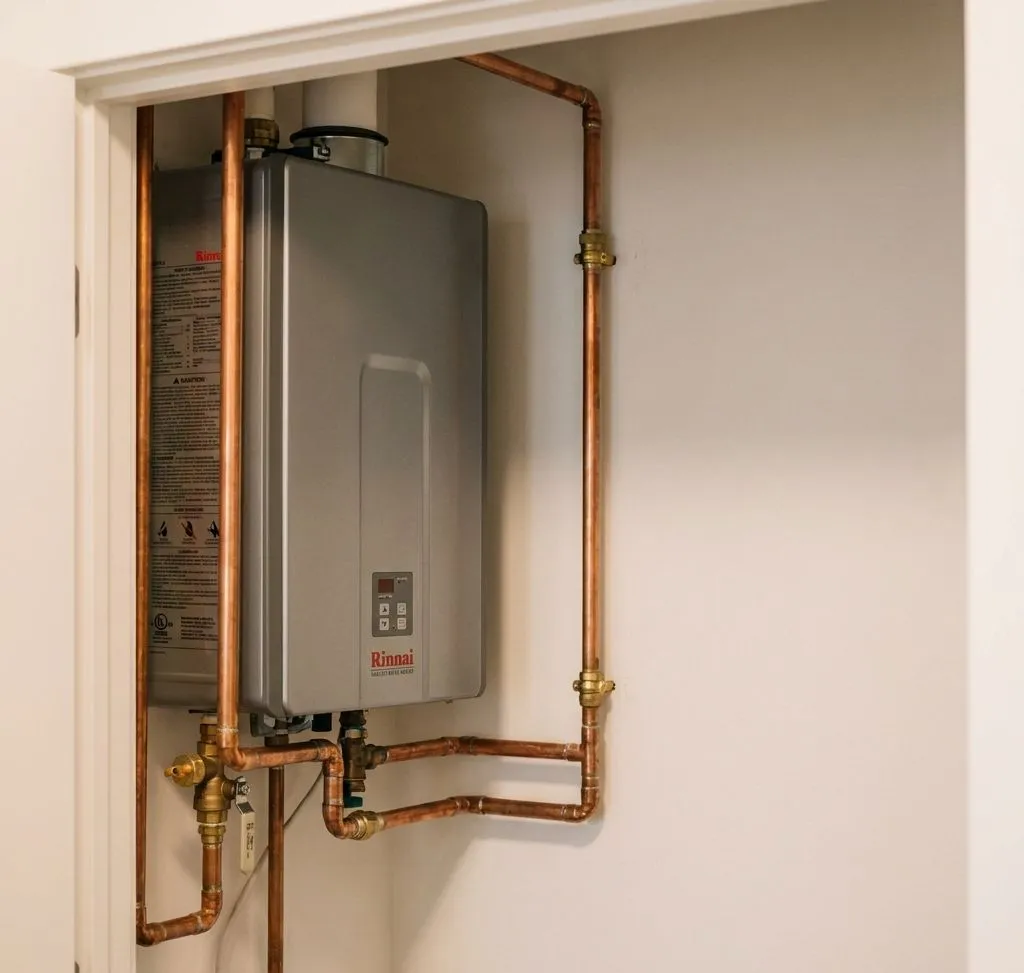
- Unit (Rinnai RU199iN or Navien NPE-240A2): $900 to $1,500
- Labor for the install itself: $600 to $900
- Gas line upsize (almost always required): $400 to $1,200
- Dedicated venting (PVC or stainless concentric): $300 to $700
- Permit and inspection: $100 to $250
- Condensate line (if condensing unit): $150 to $300
- Expansion tank removal / pressure work: $100 to $250
Add those up and you're at $2,550 to $5,100 before the unit, then add the unit cost. Most jobs land between $3,800 and $5,600 with everything done right.
The jobs that hit $6,500 are usually Frisco or Plano homes built in the late 1990s where the original gas line was undersized and we have to run a new line from the meter, not just upsize a section. That's a full day of gas work on top of the water heater install.
Why the Gas Line Is the Biggest Variable
A standard tank water heater runs on a 1/2-inch or 3/4-inch gas supply line at around 36,000 BTU input. A whole-home tankless demands 199,000 BTU or more. You cannot feed 199,000 BTU through a line sized for 36,000 BTU. It won't work, and it's not code-compliant to try.
Almost every tankless conversion we do in Carrollton, Lewisville, and Coppell requires a gas line upsize. Sometimes it's upsizing the final drop from 1/2 inch to 3/4 inch. Sometimes it's running a new branch from the gas manifold. In older homes with 1950s or 1960s black iron gas distribution, we often recommend a full gas line evaluation before committing to tankless.
If you get a quote that doesn't include gas line work and doesn't explain why, ask the question. A lot of low-ball quotes leave that piece out.
For any gas line work alongside your install, see our gas line repair and installation service.
DFW-Specific Factors That Affect Cost
Hard water scale. Dallas water at 8 to 12 grains per gallon will scale the heat exchanger in a tankless unit faster than in softer-water cities. We recommend a whole-house water softener or a dedicated in-line filter on every tankless install. Without it, you're looking at annual descaling at $150 to $300 per service. With a filter, it's every 3 to 5 years.
North Texas temperature swings. Tankless units installed on exterior walls or in garages can be exposed to temperature extremes in both directions. January freeze events in DFW have caused freeze damage to tankless units installed without proper pipe insulation. We account for this in placement and insulation recommendations on every job.
Water hardness and the heat exchanger. Navien and Rinnai both warrant their heat exchangers for 15 years. That warranty is conditioned on proper water treatment. In DFW's hard water environment, an untreated install can void the heat exchanger warranty within 5 years. We tell every customer this upfront.
Point-of-Use vs. Whole-Home Tankless
Not every job needs a whole-home unit. Here's when a point-of-use electric tankless makes more sense:
- Adding a bathroom or a guest suite that is far from the main water heater
- Detached garage apartment or workshop needing hot water
- Kitchen sink that is a long run from the water heater and has a cold-water wait time
Point-of-use electric tankless units run $800 to $1,800 installed. No gas line work, no complex venting. Much simpler job. If your only complaint is a long wait for hot water at one fixture, a point-of-use unit solves that for a fraction of the whole-home cost.
For a full comparison between tank and tankless for your situation, read our tank vs. tankless water heater guide for Texas homeowners.
How Long Until a Tankless Pays for Itself?
The honest answer: 7 to 12 years for most DFW households, based on actual energy savings data.
A tankless unit uses 25 to 40% less energy than a tank unit for the same household. At current North Texas gas rates, that's a savings of roughly $15 to $35 per month for an average family. If you spent $5,000 on the install and save $25 per month, you're looking at a 200-month payback period (about 16 years) at the low end of savings, or 143 months (about 12 years) at the high end.
The payback is better if you're replacing a tank that was already failing (you'd be spending money on a new tank anyway) or if your current unit is undersized and you're buying bottled water heaters for the second shower.
The Freeze Risk Nobody Mentions When Selling Tankless
North Texas gets one to three hard freeze events per year, averaging around 24 to 28 degrees Fahrenheit for 12 to 24 hours. That's not extreme by northern standards, but it's enough to freeze exposed tankless unit pipes if they're not protected.
The risk points are the cold water inlet line and the hot water outlet line between the unit and the first insulated section of pipe. If those runs are exposed in an unheated garage or on an exterior wall without insulation, a hard freeze can crack the connections.
We address this on every install by insulating the inlet and outlet runs, confirming the unit has built-in freeze protection (both Rinnai and Navien models we install do), and positioning the unit in the most protected location available. For garage installs, we sometimes add a low-wattage pipe heating cable on the exposed sections as insurance.
This is not a reason to avoid tankless. It's a reason to hire a plumber who thinks about it during installation rather than one who just brackets the unit to the wall and leaves.
What Maintenance Looks Like Over 10 Years
Tank water heaters are relatively low maintenance. Flush once a year, replace the anode rod every 3 to 5 years, inspect the T&P valve. Total annual time investment: about 30 minutes with a plumber doing the service call.
Tankless units require more active maintenance in DFW's hard water environment:
- Annual descaling (without water softener): $150 to $300. A vinegar solution is cycled through the heat exchanger to dissolve mineral buildup. Takes about 45 minutes.
- Filter cleaning (every 6 to 12 months): Clean the inlet screen filter. Homeowner can do this. Takes 5 minutes.
- Annual inspection (with water softener): At current scale rates with a working softener, descaling every 2 to 3 years is sufficient.
- Combustion air filter (for recirculation models): Clean or replace annually.
If you install tankless without planning for maintenance, budget $150 to $300 per year in descaling costs. That changes the payback calculation meaningfully. Factor it in before deciding.
Condensing vs. Non-Condensing: The DFW Choice
Most whole-home tankless units sold in North Texas are condensing models. The difference matters for installation.
A non-condensing tankless vents exhaust at 300 to 350 degrees Fahrenheit and requires Type B metal vent pipe (stainless or aluminum). That vent pipe runs $15 to $30 per linear foot installed. A long vent run in a two-story Plano home can add $500 to $1,200 to the install.
A condensing tankless vents at 100 to 120 degrees Fahrenheit and can use PVC or CPVC plastic vent pipe, which costs $5 to $12 per linear foot. The unit itself costs $200 to $400 more than a comparable non-condensing model, but the vent savings on a longer run can offset that.
For most DFW garage installs where the vent run is under 15 feet, the difference is minimal. For utility closet installs or second-floor mechanical rooms with a long horizontal vent run, condensing wins on total installed cost. We quote both options when the vent run is a deciding factor.
What to Ask Before You Hire Someone
Three things to verify before signing any tankless water heater quote:
- Is the gas line upsize included? Ask them to put it in writing either way.
- What unit are they installing? Rinnai and Navien are the two brands with reliable warranty support in Texas. Anything else, ask for the 10-year parts availability guarantee.
- Are they pulling a permit? In Carrollton, Plano, Frisco, and most DFW cities, a gas appliance install requires a permit. A plumber who skips the permit is skipping the inspection that confirms your gas line is safe.
Frequently Asked Questions
Do tankless water heaters work well in Texas heat? Yes. The inlet water temperature in summer is higher than in winter, which means the unit doesn't have to work as hard. Tankless units actually perform better in warm-climate states than in northern states with colder groundwater.
How long does a tankless install take? Typically one full day. Gas line work that requires trenching or significant rerouting can extend that to two days. We confirm the scope before we start.
Can I install a tankless in a closet? Yes, with proper concentric venting (both combustion air intake and exhaust in one two-pipe assembly). Most tankless units are sized to fit in the same footprint as a standard water heater closet.
Do you service The Colony and Grapevine? Yes. We cover the full northern DFW corridor from our Carrollton base. The Colony, Grapevine, Little Elm, Plano, and everywhere in between.
What brands do you install? Rinnai and Navien for whole-home gas tankless. We've been with these two for years because their warranty support and parts availability in Texas is solid. We don't install brands we can't service.